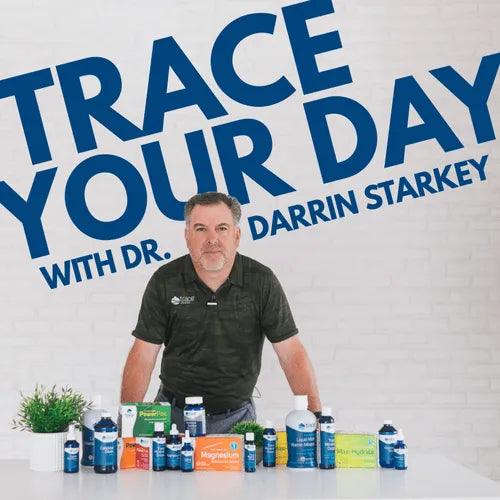


Trace Your Day – Episode 24 (Interview with Phillip; Dealing with Skin Conditions and Psoriasis)
Darrin: Hi, this is Dr. Starkey. Welcome back to Trace Your Day. You know, I [inaudible] on the podcast today with us. We have rekindled a friendship that started — how long ago, Phillip? [inaudible] He recently reached back out to share some health [inaudible] — some successes that he has experienced. And as we had this conversation, I thought, you know, this is a perfect opportunity to bring Phillip onto the podcast with us and share just a little bit about what he's experienced with his health. And maybe that'll motivate us to make some changes ourselves. Welcome today, Phillip.
Phillip: Thank you, Dr. Starkey, I appreciate it. I can't believe where time has gone — two, two and a half, three years. That's amazing.
Darrin: But some pretty amazing changes have taken place in you as well, right? Even though life is truly a journey and we face challenges of all different types — [inaudible] the way that you faced your challenges. I'd love for the listener to hear just a little bit about your background, and then of course we'll talk about some of those amazing changes in your health.
Phillip: Sounds good. Sounds good.
Darrin: So, how were you introduced to Trace Minerals to begin with?
Phillip: Well, I've always been the type of individual that listens to my body. Back in my teens, I had issues with [inaudible — acne], and I wanted to figure out what was causing it. Ultimately I got off milk, and I haven't drunk milk since probably my sophomore year in high school. And I've just learned over time to listen to my body. If you get in tune with your body, your body tells you a lot of stuff. And if you listen to it and heed the warnings it's telling you, it'll steer you clear of a lot of issues. Not every, but a lot.
Darrin: Well, of course you're willing to do — you know, there's no magic bullets here, right?
Phillip: None, none whatsoever.
Darrin: We have to make some changes, and of course the first one I heard was making some changes with the dairy intake, which is very hard to do in our society today. We love our cheeses, our milks, our yogurts. And again, I'm not saying that they're bad, but just like you said — listening to our bodies. What happened to the acne after you made those adjustments?
Phillip: It cleared up a lot — cleared up to the point where I would just have breakouts every now and again. And I was one of the unfortunate few that had the cystic variety, to the point where I couldn't even go into the military. Once I got that cleared up — unfortunately I did take a round of Accutane, but I did one round and that's all it took to knock whatever it was out of my system.
Darrin: Okay. Well, I think that's where, again, listening — you had a desire to get into the military. Sometimes we're directed in ways that… I think that's where we're at today in our society: there are opportunities available to us, but if we use them on an as-needed basis, adjust accordingly, and then feed the body properly, we can make some changes in our bodies that oftentimes have even our biggest naysayers scratching their heads, right?
Phillip: Oh, you bet. Like I said a few minutes ago, if we learn to listen to our bodies, then sometimes even minimal changes will be a lot better for us in the long run.
Darrin: Now, you've had some unforeseen stress come. I mean, who hasn't experienced, in some cases, knee-shaking, back-aching emotional stress, right?
Phillip: Right, right.
Darrin: Some things are in our control and some things are completely out of our control. But isn't it amazing what you learn through those? Some of those challenges you've experienced with that stress and how you adjusted — I'd love for you to share some of those experiences with us.
Phillip: Well, not to go into details, but a lot of times life doesn't go the way we think it should go, or the way we plan it in our minds. And we just need to learn to realize that God's in control of everything. We not only need to learn to listen to our bodies, but we need to learn to listen to God — put Him first in everything. And when you put those two together, it's amazing where it will take you.
Darrin: Right.
Phillip: It'll take you out of some of the darkest times. That's not to say you're not going to have dark times, or some misfortunes in life. But if you put those two together — pretty powerful medicine right there.
Darrin: You know, of course, those relationships, right? Those relationships with our [audio drops]. And of course, the only thing we can ultimately change is the one looking in the mirror.
Phillip: Exactly.
Darrin: And yet you made some adjustments with your health recently that you've seen some pretty profound results from with your skin. Well, let me rephrase that. The past couple of years have been absolutely amazing in so many different aspects of our lives, right? [inaudible] Many now have different types of skin conditions they've never faced in their lives — in some cases late into their 50s, 60s, and even 70s. To me, I think we need to pay attention again to what we've been through, and psoriasis seems to be that key piece that wakes us up. For some of these individuals, they cover up to the point where they don't allow themselves to go back out in public — or at least as long as they can cover up, they're good. But a lot of things they've enjoyed in life, they've altered because they don't want to shed that long-sleeve shirt.
Phillip: Right.
Darrin: But I loved, as our conversation progressed, that you shared with me some of the things you've done to help with the skin condition that you had. What was the key there?
Phillip: I think one of the most [important] things I've done over the years with my psoriasis is make sure that I stay hydrated. You need to make sure that you drink plenty of water, and I'm the type of individual who tries to drink a gallon or more a day.
Darrin: Okay.
Phillip: Not everybody can do that, right? But along with that water — I guess it's been close to 10 years now — I've been taking ConcenTrace. I've used other products throughout the years as well, but ConcenTrace has been my foundation. I use it in any water I drink. I don't care if it's bubbly water or just regular tap water, I use it in that water.
Darrin: Which I think is so vital to our health today, when the experts estimate that 75% of our society is chronically dehydrated. And yet we're drinking more water than we've ever drunk as a society. When you see water sales that have actually exceeded soda pop sales in some years — that's pretty impressive, right?
Phillip: Definitely, definitely.
Darrin: But I think the scary part of that equation is that we're drinking [inaudible — bottled/purified water]. They're void of minerals. There's no life in it. So again, I'm a huge advocate — because if I were to tell everybody, "Hey, you have to drink a gallon of water," they would swallow their tongue, right?
Phillip: They would.
Darrin: But I love the concept of — we'll make it a little simpler — take your body weight, divide it in half, and take that in ounces daily. Half your body weight in ounces of water daily. Whether you're small or large, that gives you a starting point. But then, like you said earlier, listen to your body. See how your body responds. Now, one other piece of this puzzle that you've discovered — this is a hard topic because it's so prevalent in our society — is that you cut sugar out of your diet.
Phillip: I did. I've never really been a big sweets person to begin with, so maybe that's one of the reasons it's a little easier for me to do.
Darrin: Okay, okay.
Phillip: But in the last — I guess it's been going on a month now — I've got my sugar cut down probably 88% out of my diet a day.
Darrin: So you're down to, what, 12%? Okay. I love how specific you are — 88%. And I think that's the hard part about sugar, because it's in everything. If you're not careful, if you don't know the proper terminology for some of these sugars, they sneak it in, right?
Phillip: They do, definitely. And it's easy to replace the sugars with natural sugars now. Sugar is sugar, right?
Darrin: Right, right, right.
Phillip: But I guess I kind of equate it to: if it's fruit and it's sugar, God created that. It's going to be easier for my body to break it down and utilize whatever nutrients there are in it, because it's coming from the soil.
Darrin: Right. Absolutely. And it's not processed or ultra-processed. Right. And so with that being said, what have you experienced with your health within the last [month]?
Phillip: In the last month, I've probably dropped — I could probably say maybe 12; that's really pushing it — but probably 10 to 12 pounds. And I'm at zero pains in any joint.
Darrin: Okay. Okay.
Phillip: Here in October I'll be 57, and I don't have any aches or pains.
Darrin: So let me ask you a question on that. Did you have aches and pains before?
Phillip: Oh, definitely.
Darrin: Okay. You know, it's just part of getting older, right? We all say that. As we get older, we all use it as an excuse — it's just a part of life, we're getting older. But what you've experienced — I think it's noteworthy to be able to remove that specific ingredient and see those noticeable changes in you.
Phillip: Right. And outside of prayer and God, that's really the only thing I can equate it to, because that's really the only major change I've made recently — cutting out the sugar. And I actually watch my carb intake too, so I do as little carb intake as I have to.
Darrin: What about your skin now? Did you see any—
Phillip: Oh, dramatic change. Almost to the point where it's nonexistent. And just recently I [started using] some of your magnesium oil, right? The 100% magnesium—
Darrin: Right.
Phillip: —the one that comes in a spray bottle.
Darrin: Sure.
Phillip: In the evening when I take a shower, I get out and spray that on my legs. Now, it says you can wash it off, or [that] it's going to burn. Yeah, it burns a little bit. It stings a little bit. It's not unbearable, right? And if I'm going to put something like that on my body, I'm going to let it work to its full effect. So I just leave it on.
Darrin: Okay. Now I would advise — and I'm assuming that you don't shave your legs — so for those women out there who take the time to shave their legs, I would add a little cautionary point there: stay in the shower, spray that magnesium oil on those legs, and dilute it a little bit — make sure that it's comfortable [so it doesn't] hurt at the same time. It's amazing what these minerals [can do], because they're in an ionic form, Phillip. They don't have to go through a digestive process, so they can be absorbed right through the skin. And think about that: the skin is the largest organ of our body. It's also the first line of defense in our immune system, right? So support and keep that skin healthy and strong, and if we see any type of rashes or skin abrasions or any type of soreness or tenderness, pay very close attention. And as you start to apply these minerals both topically and internally, it's amazing what our bodies are capable of.
Phillip: Definitely, definitely. And one thing I've noticed about that magnesium oil is it actually kind of puffs the skin, you know what I'm saying? It kind of tightens the skin once you put it on. And as you were saying, watch it if you shave your legs. I've had issues — when I first started using it, and every now and again I still have areas where the psoriasis is more eager to present itself, right?
Darrin: Right.
Phillip: It definitely stings a little more in those areas, but it's not unbearable.
Darrin: Okay. And of course if you have any open wounds, by all means dilute it before applying. You could get a little water bottle or [audio drops] — even if you put it into a mister, whatever it is you want to dilute it into. You can spray it into a cup, dilute it, and then apply it that way just by rubbing it on.
Phillip: Right.
Darrin: So how about the confidence levels now? Once you know that skin looks almost perfect, how's the confidence? Oftentimes with acne or these different types of skin conditions, our customers who are challenged that way — it's amazing to see their confidence in themselves increase when they feel good about their skin.
Phillip: Oh, you bet. To be honest with you, it almost drives you to a braggadocious stage. It kind of makes you puff your chest up and say, "Oh, look what I've done." But in reality, number one, the glory goes to God, right?
Darrin: Right.
Phillip: And then the magnesium — the natural stuff. [God] created that; we're using it to the benefit of our bodies. We need to keep in perspective where it's coming from, and understand that if we use the products God provides, amazing things can happen in our lives. And yes, it does give you a sense of confidence — and amazement for other people who know what you're going through and have seen your psoriatic condition really flare up, and then see it when it's at a more clear stage. They're just like, "Wow, it really works."
Darrin: I love when you become kind of that North Star for those individuals around you — friends, family, loved ones, right? When they identify it — and of course they're the ones who want to talk about it — I love when it comes back and they ask, "Well, what are you doing, Phillip?" And what I love about what you've experienced is it's repeatable at all ages, right? I don't care if you're a day old or 105 years old. You can teach what you've done for yourself, and the results are the same.
Phillip: Here's the thing: it comes with effort. You can't set it on a shelf and look at it. You have to put it in or put it on to see results.
Darrin: And once you get results, remember — I think we should take the word "healed" out of our vocabulary. There's no purpose for it, because we're never 100% healed. We're always healing. We're always improving. We're always maintaining or trying to sustain that balance, right? Because the minute you walk out your front door, Phillip, and walk into society — as soon as you take a big deep breath of air and you smell exhaust — your body's healing from something. It's being attacked. What frustrates me sometimes is we get these individuals who have amazing results, and then they start [skipping] it because they think, "Well, I don't need this." And it's amazing how fast it comes back, right? It's amazing how long it takes to improve our health or lose the weight or whatever it is you're focused on — but when you stop maintaining that, whether it's a supplement program or just a lifestyle change, it's amazing how fast it comes back to us if we're not careful.
Phillip: Oh, you bet. It's kind of like [inaudible] people who take medication for one thing or another. I've known a lot of people who do that: whatever issue they're taking it for gets better, and then all of a sudden they stop — "Oh, okay, well, it's all gone." And then three months later they're worse than they were before they started the medication. "I don't understand what happened." Because you didn't maintain. So once you get your condition under control, you need to maintain. You need to do a maintenance program, and that requires discipline.
Darrin: That's a tough word right there. That's like saying "patience," right?
Phillip: It is, definitely. And that's something I work on every day of my life.
Darrin: Right, right. So one thing we want you, our listeners, to know today is that there's hope. There's hope in so many different aspects of our life — whether it be emotional, mental, physical, or spiritual. I think they're all intertwined. If we're not working on [all of them] — kind of like spokes on a wheel, right? You remove one, and that portion of the wheel will eventually go flat, or of course we're going to have to adjust — as we maintain consistency. And I think consistency, Phillip, is the key word here: we have to be consistent with ourselves. And I hope we're taking really close notes on our own personal well-being, because we know ourselves better than anybody else, right?
Phillip: Oh, you bet, you bet. Nobody can tell me what's going on inside my body outside of me.
Darrin: Right, right. And of course what's happening to your body right now, especially with what you've been through personally, I think is amazing.
Phillip: I would agree with you 100% on that.
Darrin: Keep doing what you're doing. Thank you so much for sharing with us what you've personally overcome. And more importantly, as we move forward, those of you who have questions — whether for me or for Phillip — please reach out. Send us a text, an email, a post. Let us know; we would love to answer your questions. Until next time, best of health.
Announcer: Thanks for listening in. If you have any topics you want covered, let us know on our Instagram page at Trace Minerals Research. We'll see you back here next week on Trace Your Day.